
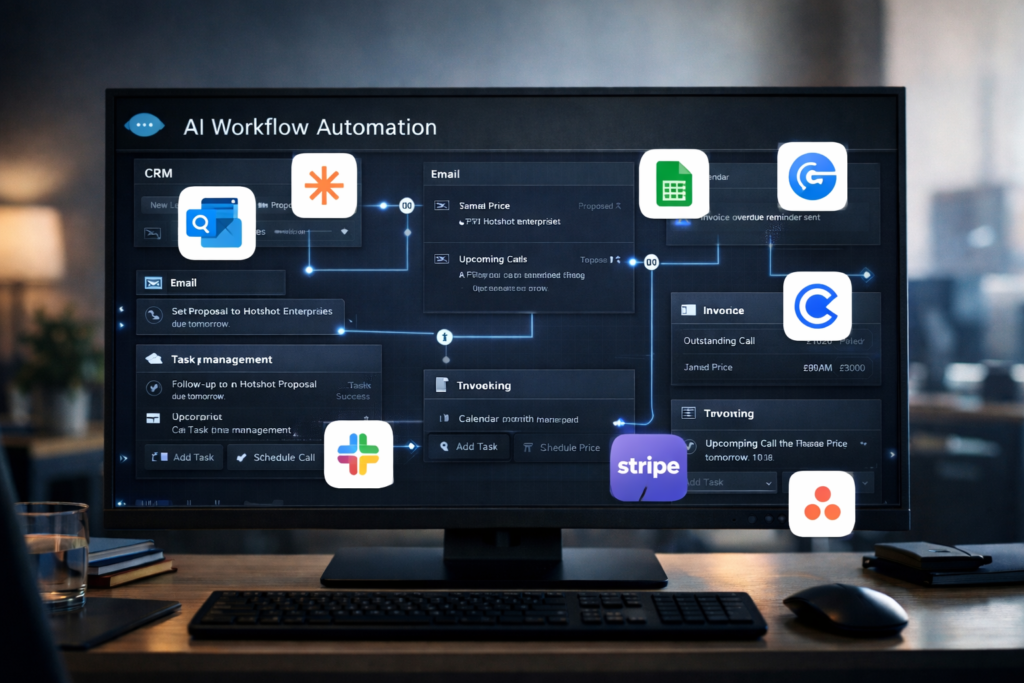
For many UK SMEs, growth doesn’t stall because of lack of ambition. It stalls because of capacity.
There are only so many hours in the day. Only so many emails a team can respond to. Only so many admin tasks that can be completed before productivity starts to suffer.
This is where AI workflow automation is quietly transforming how smaller businesses operate.
It’s not about replacing teams. It’s about removing friction.
The Hidden Admin Burden in SMEs
In most small and medium-sized businesses, teams wear multiple hats. Sales teams manage follow-ups and CRM updates. Operations teams handle scheduling and supplier communication. Directors often jump into inboxes to keep things moving.
Over time, repetitive tasks accumulate:
- Manually logging leads into CRM systems
- Sending follow-up emails
- Updating spreadsheets
- Booking appointments
- Chasing invoices
- Routing enquiries to the right department
None of these tasks are complex — but together, they consume a significant portion of the working week.
AI workflow automation addresses exactly this kind of friction.
What AI Workflow Automation Actually Does
At its core, workflow automation connects systems and triggers actions automatically based on defined rules.
When enhanced with AI, those workflows become smarter.
For example:
- A website enquiry is automatically logged in your CRM, categorised by intent, and assigned to the correct sales rep.
- A proposal sent but not opened within five days triggers a follow-up reminder.
- A new customer automatically receives onboarding emails and internal tasks are created for the operations team.
- An unpaid invoice triggers a polite reminder email after a set period.
Instead of relying on manual action, the system ensures momentum.
AI adds an extra layer of intelligence — detecting urgency, analysing sentiment, prioritising high-value leads, or suggesting next best actions.
The result is not just automation. It’s structured, intelligent movement within the business.
Protecting Revenue Through Speed
In competitive markets, speed matters.
The quicker you respond to a new lead, the more likely you are to convert them. The quicker you onboard a client, the more professional the experience feels. The quicker you follow up, the less likely opportunities are to go cold.
AI workflow automation reduces delay between action and response.
For UK SMEs competing against larger brands with bigger teams, this creates a powerful levelling effect. You may not have the headcount — but you can match the responsiveness.
And responsiveness builds trust.
Improving Accuracy and Reducing Errors
Manual processes introduce risk.
Data entry mistakes. Forgotten follow-ups. Missed deadlines. Duplicate records.
Automation reduces these risks by enforcing structure. Fields can be made mandatory before progressing. Notifications can trigger when deadlines approach. Duplicate entries can be flagged automatically.
Cleaner systems lead to better reporting. Better reporting leads to stronger forecasting. And stronger forecasting enables more confident decision-making.
For SMEs looking to scale sustainably, this kind of operational discipline is invaluable.
Freeing Teams to Focus on High-Value Work
Perhaps the most important benefit of AI workflow automation is what it removes.
It removes the constant cognitive load of remembering every next step. It removes repetitive drafting. It removes the need for constant manual reminders.
When admin pressure decreases, teams can focus on:
- Building client relationships
- Refining strategy
- Improving products and services
- Generating new business
This shift doesn’t just improve efficiency — it improves morale. Teams feel less overwhelmed and more productive.
Scalable Growth Without Proportional Hiring
Hiring additional staff is expensive. Salaries, pensions, onboarding time, management overhead — the true cost is significant.
AI workflow automation allows SMEs to increase output without increasing payroll proportionally.
A small team supported by intelligent automation can operate with the structure and responsiveness of a much larger organisation.
That scalability is especially valuable in uncertain economic conditions, where cautious growth is essential.
It’s Not About Complexity — It’s About Clarity
One misconception is that automation requires complex technical infrastructure.
In reality, the most effective implementations start small:
- Automate lead capture and routing.
- Introduce structured follow-up sequences.
- Automate onboarding workflows.
- Connect invoicing with reminders.
As value becomes clear, additional layers can be introduced.
The goal isn’t to over-engineer the business.
It’s to reduce friction, protect momentum, and ensure no opportunity is lost due to oversight.
The Bigger Picture for UK SMEs
AI workflow automation is not a trend reserved for tech companies. It’s an operational upgrade available to businesses across sectors — professional services, property, retail, healthcare, manufacturing, and beyond.
For UK SMEs facing rising costs, increasing customer expectations, and competitive pressure, working smarter is no longer optional.
Automation doesn’t remove the human element.
It protects it — by ensuring your people focus on what truly drives growth.
The businesses that embrace intelligent workflow automation won’t necessarily work harder.
They’ll work smarter.